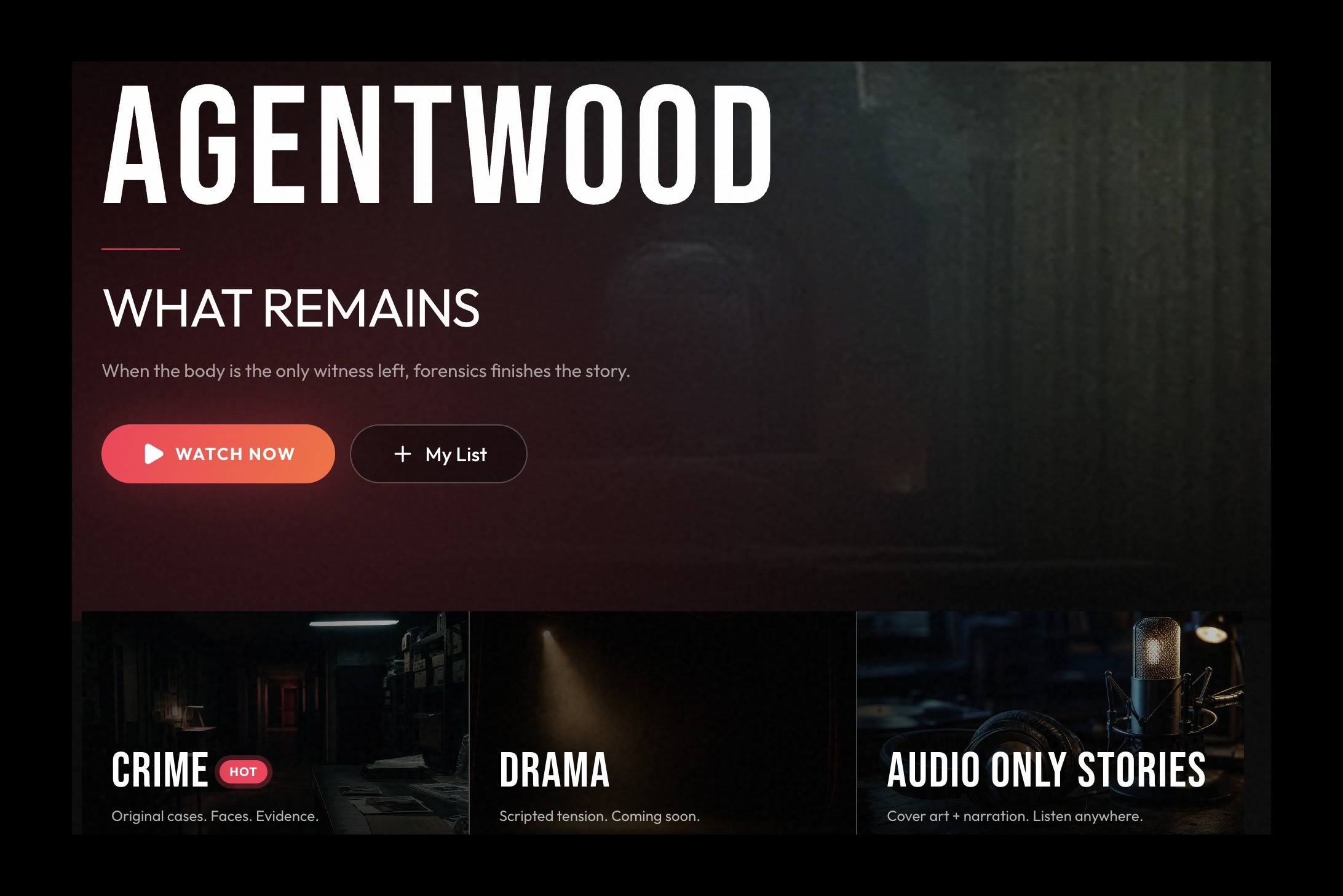
Introducing Agentwood Studio
We built an AI production system for the Agentwood Shorts app — not another “type a prompt, get a clip” toy.
Most AI video tools are great at demos. You type something. You get a short clip. You export it. Done.
That falls apart the moment you try to ship a real show: same narrator every episode, captions that match the voice, visuals that don’t repeat the same image twenty times, music that sits under the story, and a finished file that actually shows up in the app.
Agentwood Studio is how we solve that. It’s the production pipeline behind Agentwood Shorts — package in, publishable episode out.
Why it’s different
Consumer AI editors optimize for speed and novelty. One prompt → one disposable clip. Fine for social experiments. Useless for a slate.
Agentwood Studio optimizes for constraints — the boring stuff that makes a show feel like a show:
| Typical AI clip tool | Agentwood Studio |
|---|---|
| New voice every run | Locked house voice across the series |
| Captions “close enough” | Script force-aligned to real audio |
| Same image reused endlessly | Unique-shot rule (key shots only may repeat) |
Stops at export.mp4 | Publishes into the Shorts catalog |
| One-off demos | Repeatable weekly throughput |
The short version: demos maximize surprise. Studios maximize identity, sync, and delivery.
That’s the gap we built for.
Why we built it
We needed weekly content for Shorts that still felt produced — not like a slideshow with a robot reading over it. From day one we locked:
- Voice identity stays fixed across episodes
- Captions follow the audio, not a guess
- Every shot earns its place
- Music ducks under speech like a real documentary bed
- Finished episodes land in the app automatically
If it isn’t repeatable, it isn’t production.
How it works (technical view)
Studio is a staged pipeline — a directed chain of steps, not a single model call. Stochastic generation only happens where we allow it (for example motion recipes). Everything else is deterministic and script-locked.
Package → TTS (voice lock) → Align → Captions
                ↓                         ↓
          Narration WAV              ASS / karaoke
                └────→ Motion B-roll ←────┘
                           ↓
                      Music bed
                           ↓
                   Mix + burn + publish
                           ↓
                    Shorts catalog / feed
1. Package
Input is a structured narrative package: beat-indexed script, shot IDs, voice lock. Not a freeform chat prompt. The package is the contract — every later stage reads from it.
2. Voice (TTS)
Narration is cloned from a locked house voice. Same timbre and pacing every episode (around 145 words per minute for documentary feel). Light EQ only — we preserve the clone, we don’t restyle it per run.
Why it matters: long-form dies when the narrator “sounds different every Tuesday.” Voice is treated as an invariant, not a style slider.
3. Align + captions
We timestamp speech against the script (forced alignment), then pack words into gapless on-screen lines.
Why it matters: captions that merely resemble speech destroy trust. This is script-locked typography with acoustic timestamps — not “AI captions.”
4. Motion B-roll
Each caption span maps to a visual plate, then a Ken Burns-style move (push / pull / pan — no micro-shake spam).
Cardinality rule: normal plates appear once. Only a small key-shot set (opener, portraits, signature symbol, closer) may repeat.
Why it matters: that single rule is the difference between a documentary and a loop of the same image.
5. Music bed
A documentary underscore loops for the full runtime and soft-ducks under narration (voice sits on top; bed fills the gaps). The bed stays audible, not ornamental.
6. Mix + publish
Voice, picture, captions, and music assemble into a device-safe master. Then the terminal step writes catalog metadata and a public path the Shorts feed can hit.
If it isn’t in the catalog, it isn’t an episode. Delivery is part of the model — not a manual afterthought.
In one line:
Script → locked voice → synced captions → constrained motion → ducked music → app catalog.
Under the hood (for the curious)
| Layer | Role |
|---|---|
| Studio surface | The named production system we run for Shorts |
| Factory engines | Low-level TTS, alignment, motion, mix, and burn |
| Publish step | Writes masters + catalog entries the app feed can play |
Target runtime is roughly 10–20 minutes per episode. First vertical: true-crime documentary shorts (including The Shadow Killer), feeding Agentwood Shorts end-to-end.
What this means for Shorts viewers
You don’t see a pipeline. You see episodes that feel consistent: same narrator, readable captions, paced cuts, and a mix that sounds finished.
For us, Studio is the difference between “we generated a clip” and “we shipped a slate.”
What’s next
We’re opening the same stack for licensing — for studios, publishers, and product teams that need repeatable output with a house voice and catalog delivery, without a 40-person post bay.
You bring the story, voice seed, and visual library. Studio runs the line.
Bottom line
Agentwood Studio is the production system behind Agentwood Shorts. It’s different because it optimizes for constraints — locked voice, force-aligned captions, unique-shot discipline, music as a real track, and publish into the app — instead of one-shot novelty.
Not a prompt box. A studio.